


Seller's Guide
Rolex Trade-In vs. Selling Outright: What You Actually Get
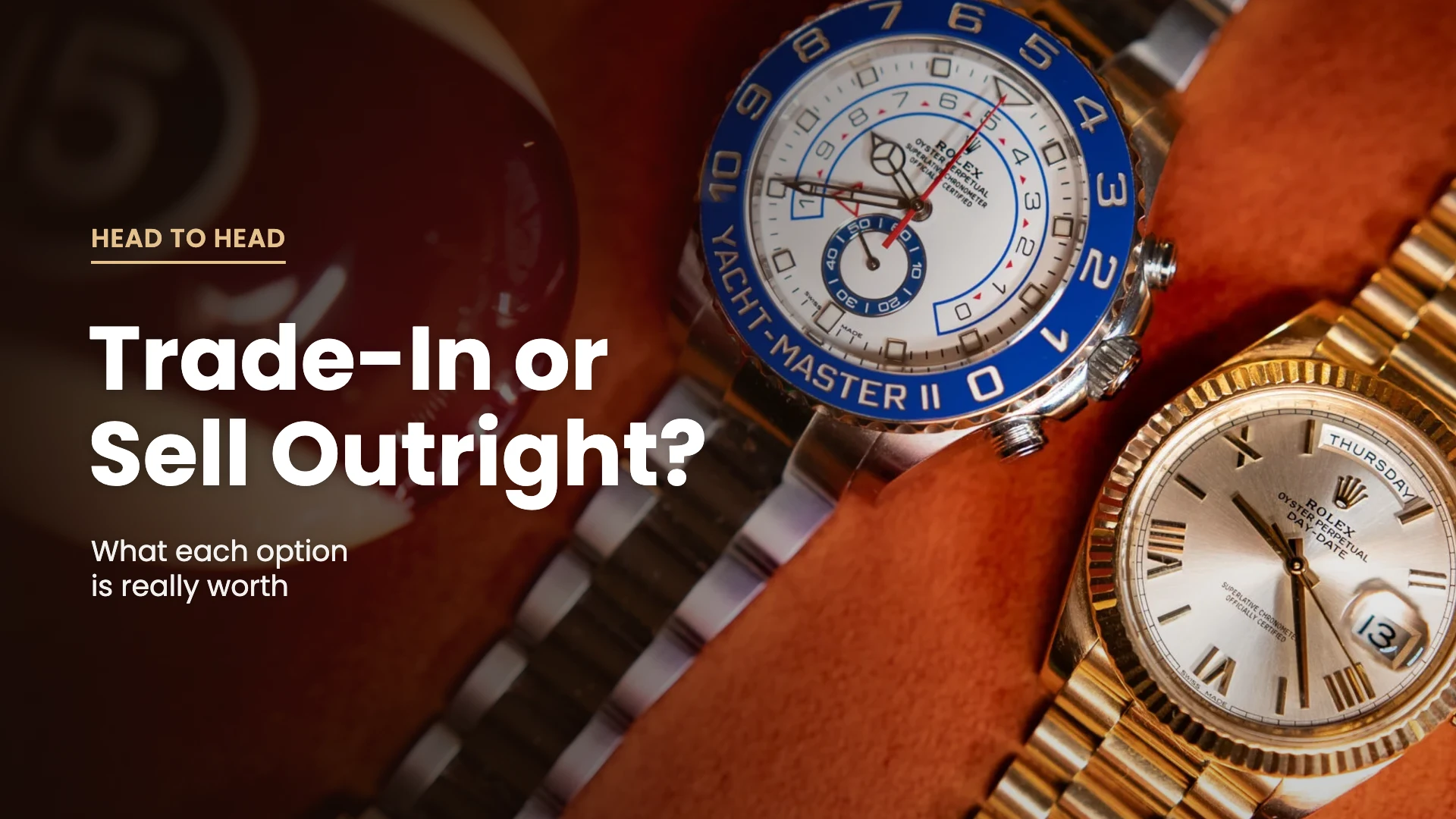
Store credit or cash? How each one works, and the simple way to compare them so you know which is really worth more.
The short answer
A trade-in gives you credit toward another watch from the same seller; selling outright gives you cash you can use anywhere. Trade-in credit can look higher, but it is tied to the price of the watch you buy next. To compare fairly, get a cash offer first, then judge any trade-in against it.
Two ways to turn a watch into something else
When you are ready to move on from a Rolex, you usually have two routes. You can trade it in at a dealer and put its value toward another watch, or you can sell it outright and walk away with money. Both are legitimate, and the right choice depends on what you want next. What trips people up is comparing a trade-in number with a cash number as if they were the same kind of money.
How a trade-in works
A trade-in is a credit, not a payment. The dealer values your watch and subtracts that figure from the price of a watch they are selling you. A few things follow from that:
- The number depends on the next watch. A dealer may show you a generous trade-in figure on a watch they are keen to sell and a lower one on another. The figure that matters is the difference you pay.
- You stay within one inventory. The credit is only worth something if that dealer has the watch you actually want, at a price you are happy with.
- It can be the simplest option. One visit, one transaction, and you leave wearing your next watch. For many people that convenience is worth a lot.
Not every authorized Rolex dealer takes trade-ins, and policies vary from store to store. Rolex’s own Certified Pre-Owned program, sold through authorized dealers, has grown quickly, with sales estimated at $594 million in 2025 by the data firm EveryWatch, so the option is more widely available than it once was.
How selling outright works
A direct sale turns your watch into cash. A buyer looks at the reference, condition, box and papers and what comparable watches are selling for, then makes an offer. If you accept, the watch is verified and you are paid. You can then buy anything you like, from anyone, or nothing at all.
The trade-off is that you handle two transactions instead of one. If you are buying another watch anyway, that is a short extra step, and it gives you a clear, portable number.
How to compare the two on equal terms
- Get a cash offer first. This is your baseline: what the watch is worth with no strings attached.
- Ask for the trade-in as a net figure. What do you pay, out of pocket, for the new watch after the credit? Write it down.
- Price the new watch separately. What would that same watch cost you without a trade? If the dealer’s price on the new watch is higher than you could find elsewhere, a high trade-in figure may be partly offset.
- Compare the totals. Cash offer plus the best price you can find on the next watch, versus the net amount on the trade. The smaller out-of-pocket total wins, all else being equal.
- Ask about tax. How sales tax applies to a trade-in differs by state and by store, so ask the dealer to show it on the paperwork.
| Trade-in | Sell outright | |
|---|---|---|
| What you receive | Credit toward one store’s watches | Cash you can use anywhere |
| Best for | Buying your next watch from that store today | Keeping options open, or not buying again |
| How to judge it | The net amount you pay for the new watch | The offer itself |
| Time | One visit | A few days, including insured shipping and verification |
What a direct buyer looks at
Whichever way you go, the same details decide the value of your watch:
- Reference number. It identifies the exact model and generation. See our guide to Rolex serial and reference numbers.
- Condition. Scratches are normal. Heavy polishing, replaced parts or a stretched bracelet matter more. Here is whether to service your Rolex before selling.
- Box and papers. A full set is easier to resell, and buyers pay for that.
- Current demand. Some references sell within days; others take longer. Our post on how much your Rolex is worth goes further into this.
Our take
If the next watch you want is sitting in the case in front of you at a fair price, a trade-in can be the right call. If you are not sure what is next, or you want to shop around, cash gives you more freedom. In both cases, knowing your cash number first puts you in a stronger position. We do both ourselves: you can sell your watch to us outright, or put its value toward a piece from our inventory. For where the market stands right now, see Rolex prices in 2026.
You can get a cash offer on your Rolex online, usually the same business day, with no obligation to sell. If you are near North Georgia, you can also visit our Blue Ridge store by appointment.
Common questions
Is it better to trade in or sell a Rolex?
It depends on whether you are buying your next watch from the same store. Compare the net cost of a trade with a cash offer plus the best price you can find on the next watch.
Do Rolex dealers accept trade-ins?
Some do and some don’t, and terms vary by store. Ask the dealer directly.
Why is a trade-in figure sometimes higher than a cash offer?
Because the credit can only be spent with that dealer, often on a watch sold at full price. The real comparison is what you pay in the end.
This article is general information, not financial or tax advice.
Sources: WatchPro, May 2026 (EveryWatch data).